

A WH catalog number tells you less than it looks like it should. In the entries examined here, the prefix appears under Workhorse Music Group, a Los Angeles company that ran two record labels with deliberately different rosters, and WH numbers appear across both imprints. WH06 and WH17 use the same prefix while identifying records associated with different parts of the company.
The company explained the arrangement itself, on a page the Internet Archive captured in July 2013: “Workhorse is a new music group encompassing two record labels and an artist management division.” This guide is built from those captured pages, with catalog numbers read from the community release index. Staple News holds one of the domains involved and has no connection to the company.
Three divisions, one company
The site ran four sections and the middle two describe the business: Labels and Artist Management. The about page put the split between the labels in one sentence, and it supplies a direct account of how the company presented its imprints. Staple Records took bands rooted in punk, pop and post-hardcore. Density Records took the heavy end, and the page said so in exactly those terms, down to a cheerful aside about the company’s fondness for metal.

The about page also sidesteps a founding date. It offers experience instead, describing the people running it as industry veterans with more than three decades between them, and the footer carries a 2012 copyright line that does not establish when the company began. Nothing read for this guide gives a year the company started.
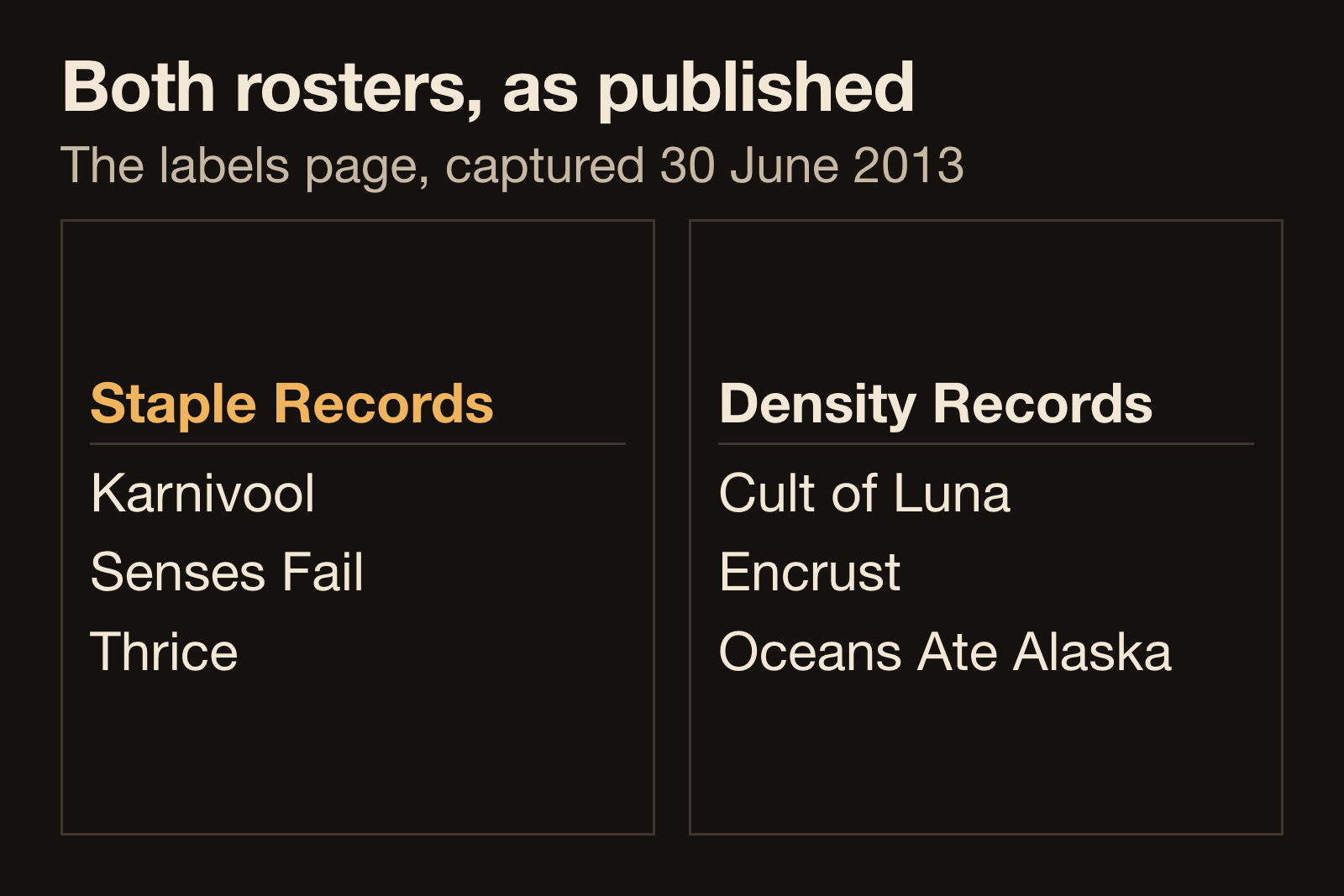
Two rosters, published side by side
The labels page listed three acts under each imprint when it was captured on 30 June 2013. It is a dated snapshot, not evidence that the labels represented only those six acts throughout their history.
The inspected management page had fewer names. Its page, captured that November, carried one artist heading: Senses Fail. That fits with the sister label’s contact page, where two named staff, Wayne Pighini and James Nielsen, were both reachable at the Workhorse domain rather than at a Staple address.
How to read a WH number
The numbers observed in the community index run from WH02 to WH65 and carry years from 2012 to 2015. WH01 does not appear in the rows read, and there are gaps throughout, so the sequence should be treated as a range with holes rather than a complete run.
| Number | Year | Release |
|---|---|---|
| WH02 | 2012 | Senses Fail, Still Searching |
| WH06 | 2012 | Oceans Ate Alaska, Into The Deep |
| WH13 | 2013 | Cult Of Luna, Vertikal |
| WH17 | 2013 | Senses Fail, Renacer |
| WH23 | 2013 | The Get Up Kids, Eudora |
| WH25 | 2013 | Karnivool, Asymmetry |
| WH47 | 2014 | Frank Iero’s band, Stomachaches |
| WH59 | 2015 | Dustin Kensrue, Carry The Fire |
| WH62 | 2015 | Lorna Shore, Psalms |
| WH65 | 2015 | Red City Radio, Red City Radio |
Read down that column and the interleaving is obvious. Oceans Ate Alaska’s EP uses WH06 and Senses Fail’s Still Searching uses WH02; Cult Of Luna’s Vertikal uses WH13 and Renacer uses WH17. The inspected entries use the prefix across both imprints, so it cannot identify the imprint by itself.
One pattern in the numbers is worth knowing before you buy. Several albums take two consecutive numbers, one per format, so the pair belongs to a single record rather than to two. In the rows read, WH03 and WH04 are both Thrice Anthology, WH17 and WH18 are both Renacer, WH47 and WH48 are both Stomachaches, WH59 and WH60 are both Carry The Fire, and WH64 and WH65 are both the Red City Radio album. The selected entries put a CD under the lower number and vinyl under the higher number in those five pairs. Renacer also has a CD entry using WH18, plus an orange vinyl entry using WH19. The shared numbers and differing entries mean this pattern cannot identify every edition; compare the specific format and barcode as well. The Cult Of Luna pair runs the other way, WH12 on the double LP and WH13 on the CD, which is a good reason to check the format rather than assume the order. The WH47 and WH48 pair belongs to Frank Iero’s first solo record. Two other records complicate the pattern: La Dispute’s Rooms Of The House carries three different WH numbers across its issues, and the So Many Ways EP is entered on the imprint with no catalog number at all.
Some entries settle the question anyway, because they carry both names. Rows in the Staple Records index include the catalog numbers WH18, WH23, WH24, WH32, WH34, WH38, WH42, WH47, WH48, WH54, WH59, and WH60, which is a Workhorse number plus a Staple imprint on the same record. Those fields show the company and imprint being credited together; inspect the physical package before assuming where either name is printed.
Counted as a whole, the index for the company lists 87 rows on a single page, against 130 for the Staple imprint. Neither figure is a release count. Index rows include variants, promos, and reissues separately, so they describe a database rather than an output. The overlap between the two is where the Senses Fail catalog lives.
Where the trail ends
Captures of the company site cluster in 2013 and thin out afterwards. By 2019 the same domain was serving pages with names like service.php and work.php, which are not company pages and say nothing about the company. No announcement, no final release note, and no closing statement appears in anything read here. Our editorial standards cover how to send a correction if one turns up.