

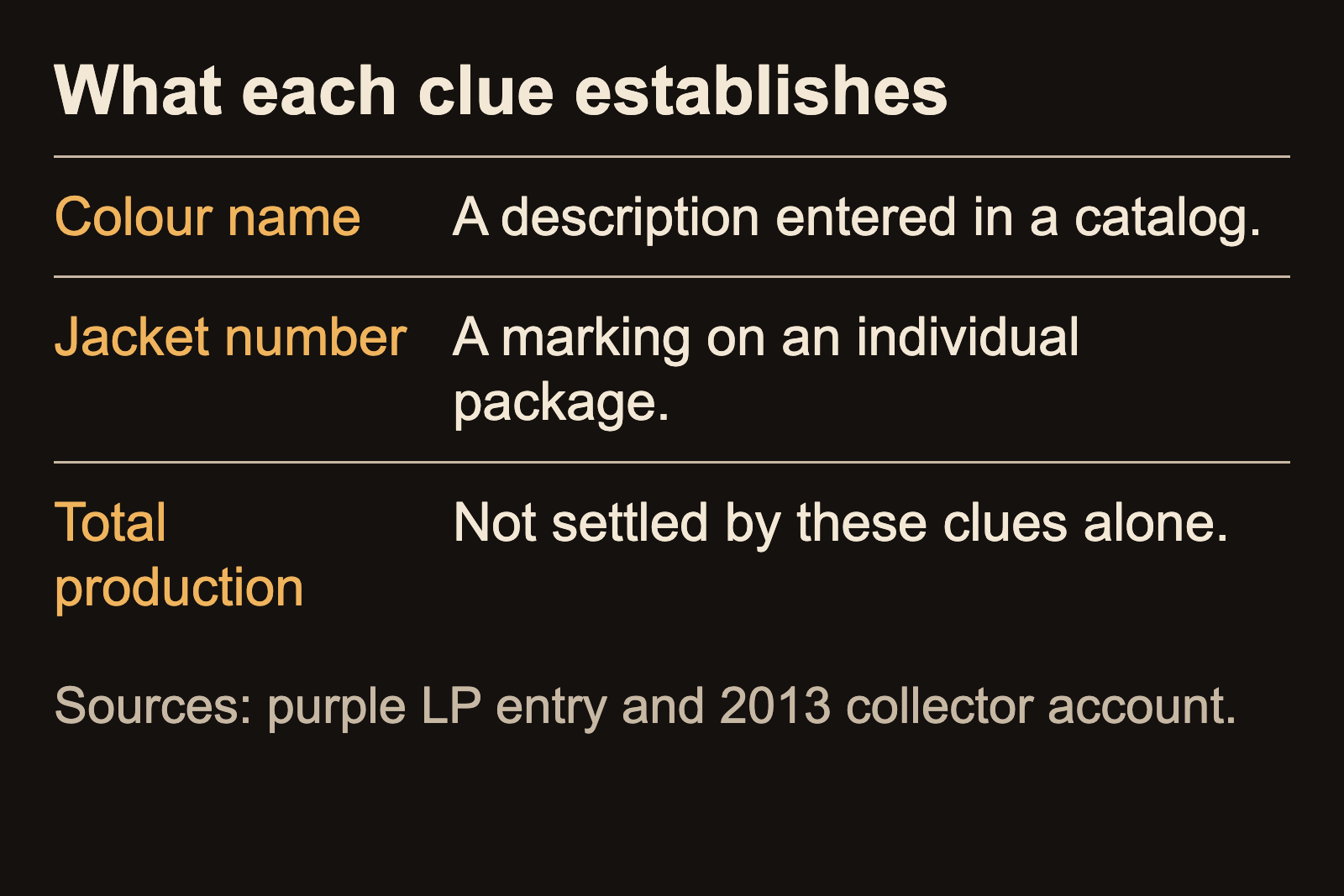
Renacer’s 2013 vinyl listings use three colour names: purple, orange/green marble and orange/yellow swirl. That does not settle whether the two orange descriptions represent separate manufactured runs. The catalog entries preserve both names; a contemporary collector disputed the distinction after comparing photographs. Adding their announced quantities produces a total the available evidence cannot support.
This guide compares selected physical entries and the original collector report. The Senses Fail release guide places Renacer in the band’s chronology. Here, the task is narrower: identify a copy using format, jacket details and catalog information while keeping the uncertain pressing total out of the answer.
The numbered purple edition
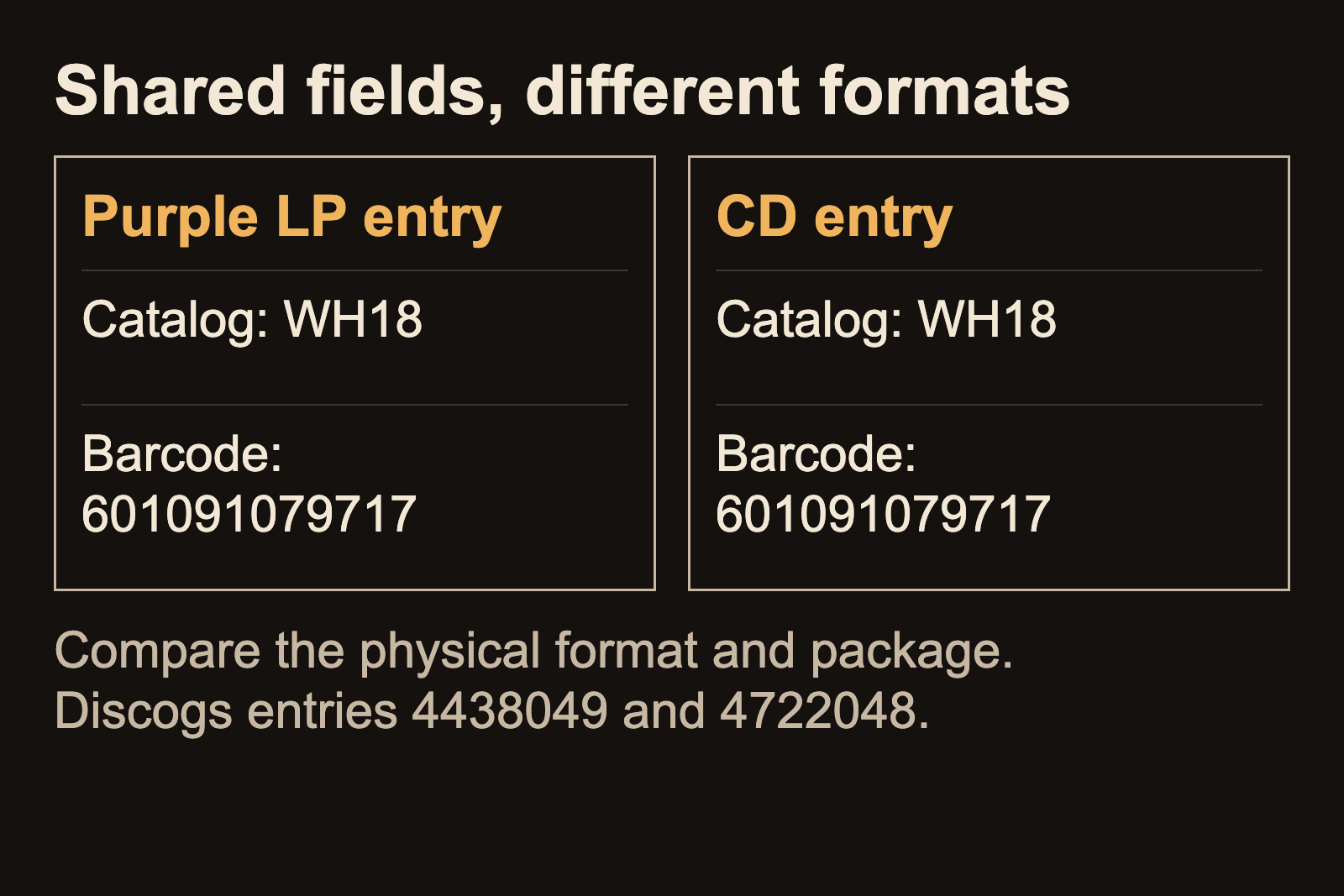
The purple LP entry records 26 March 2013, credits Staple Records and Workhorse Music Group, and gives WH18. Its notes transcribe a front sticker identifying purple vinyl and 500 copies, plus a gold foil number on the reverse of the jacket. The barcode entered is 601091079717.
Those details provide several things to compare with a listing: the record colour, the sticker, the number on the back and the catalog fields. A photograph of only the front cover leaves some of that evidence out. The 500-copy statement is what the entry records from the sticker; it is not a count of copies currently available or still in good condition. The album’s 2013 press coverage is collected separately, as is the Montclair release show the label announced for it.
Discogs is a community-maintained catalog. The entry was read for this guide, but no physical purple copy was inspected. Its transcription is useful evidence with that limitation attached.
Two orange names in the catalog
The orange/green marble entry uses WH19 under Staple Records. It transcribes a sticker describing that colour and 500 copies. The orange/yellow swirl entry uses WH18 and describes 500 copies later announced through the band’s webstore. Both entries give 26 March 2013.
The WH19 field should remain visible when comparing them. Quietly replacing it with WH18 would conceal a real difference between the records being consulted. Neither orange entry supplies a runout or barcode in the inspected data, so those missing fields cannot be used here to resolve whether the names identify separate pressings.
Each entry has the same twelve-song sequence, with six tracks on each side. The shared program establishes no bonus-track distinction between those entries. It also cannot tell a reader whether two orange discs were pressed in separate batches.
The uncertainty was already there in 2013
A Stitches and Grooves collector post dated 1 April 2013 describes the problem as it unfolded. Purple copies had been offered online and orange/green copies announced for touring. An orange/yellow swirl listing then appeared online, leaving the writer unsure whether it was another variant or the tour edition under a different description.
In a mid-April update, the writer said photographs of tour and online orange copies looked “practically identical” and inferred a smaller total. That is a collector’s interpretation of photographs, not a label or plant production record. It is enough to challenge simple addition of the announced counts. It does not establish a definitive total of its own.
The same account describes numbered jackets for purple and orange copies and reports inconsistent colour wording on some stickers. It also describes a foldout insert and download card. Those observations make package photographs useful, but they do not authenticate an unseen copy.
WH18 and a barcode can cross formats
There is another reason to check the object alongside the number. The WH18 CD entry carries the same 601091079717 barcode as the purple LP entry. That is a collision in the catalog fields being consulted. It does not prove which entry, if either, needs correction.
A separate Workhorse CD entry uses WH17, barcode 601091079625 and a matrix containing WH17. It credits Shaun Lopez with production and engineering and Eric Stenman with mixing and engineering. These are edition-specific catalog and credit details, not a reason to merge the two CD entries or treat a CD as the vinyl listing.
For a seller’s copy, format is observable evidence. Compare that first, then the label and catalog number, then the barcode and matrix where available. A number copied into a sales listing can only take the identification so far.
The test pressing has no established quantity
The WH18 test-press entry records an LP and explicitly leaves the quantity unknown. It lists the same album program. No numbered run should be assigned from assumptions about how many test copies a plant usually makes.
In a May 2024 discussion, a listener looking for Renacer prompted replies hoping for a repress and suggesting resale channels. That exchange shows the practical buying question, not current availability or a repress announcement. This guide therefore gives no price target or stock claim.
For the commercial editions, request photographs of both jacket sides, the sticker, the record and any runout. For a test pressing, ask for the identifying documentation as well. Keep a colour name separate from a verified production count. If new label documentation settles the orange variants, our corrections process provides a way to update the guide.