

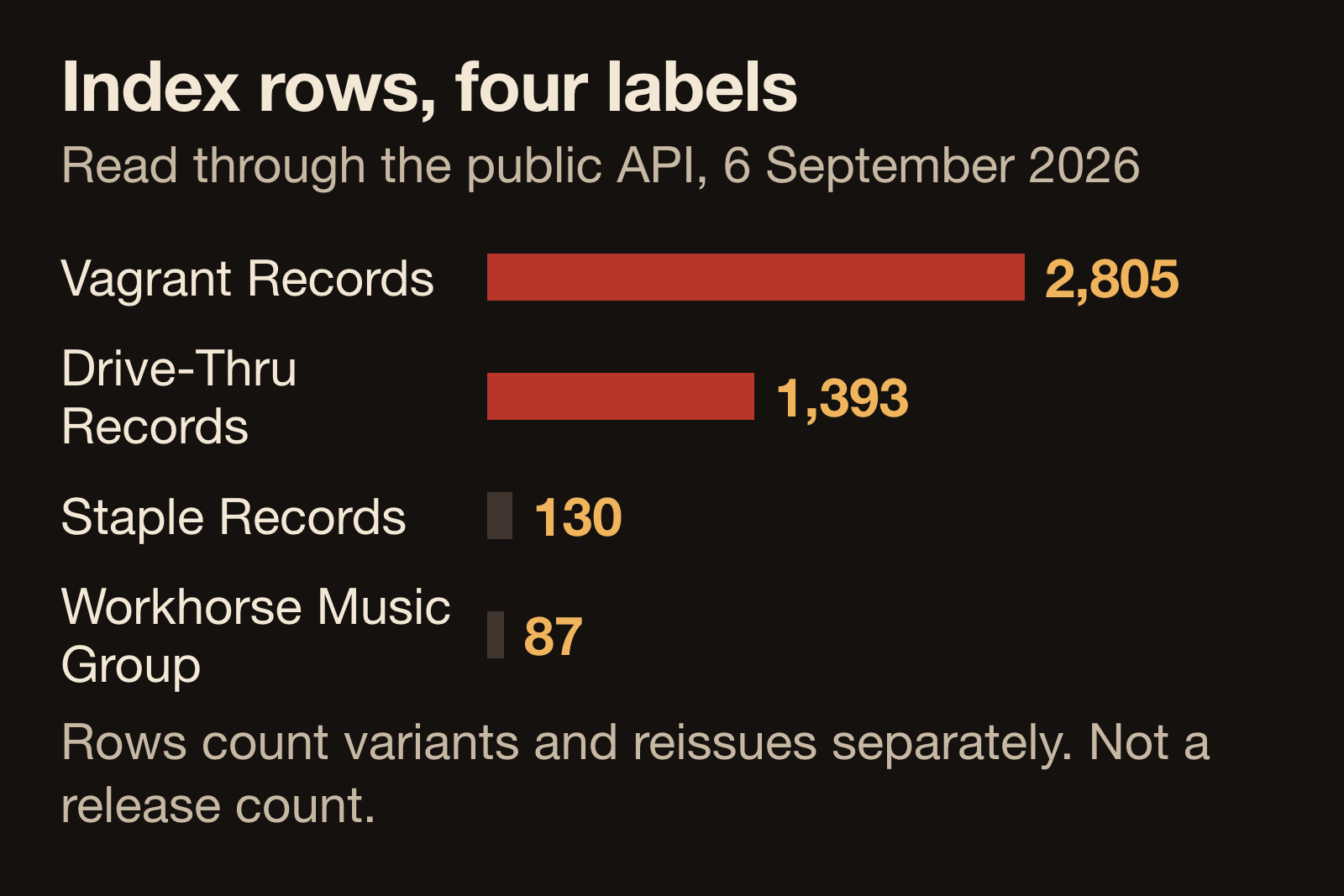
Vagrant Records’ catalog connects bands such as Senses Fail and The Get Up Kids with artists including Eels and Paul Westerberg. Its community release index runs to 2,805 rows across twenty nine pages, and a single page of that index carries thirty artists working in rock, folk, soul and pop.
The catalog can be examined through both artist names and individual release entries. This guide uses index counts for size, the label’s own live site for the present, and a dated trade report for the 2014 sale. Staple News has no connection to any label named here.
How big the catalog actually is
Counting index rows describes the database snapshot examined here. Rows include variants, promos, reissues and compilations separately, so 2,805 describes a database rather than an output. It is useful for comparison, though, because the same measure applied to the other labels this site covers puts the difference in proportion.
Catalog numbering is not one system either. On a single index page the numbers appear as VR381, VR-0387, VR 515 and VR4405, alongside an HV prefix on other rows, a bare distributor string, and entries with no number at all. If you are trying to date a Vagrant pressing from its number, the format alone will not do it.
The roster is wider than the reputation
One page of the index, sorted oldest first, carries Alkaline Trio, The 1975, The Get Up Kids, Edward Sharpe and the Magnetic Zeros, Paul Westerberg, Eels, Reggie And The Full Effect, Dashboard Confessional, The Anniversary, The New Amsterdams, Saves The Day and Senses Fail, among thirty distinct names.
The Senses Fail connection is the one this site has already followed. The 2004 debut album entry carries the Vagrant imprint with catalog number VR-0403-2, and the four albums that band released through 2010 all sit under the same name, which is why that release history keeps returning to it.
What the 2014 sale actually covered
The sale was announced on 17 November 2014. It was not a licensing arrangement or a distribution deal: the report of the announcement states that BMG acquired “the entire Vagrant catalogue, as well as its rights to future recordings.” A Vagrant co-founder, Jon Cohen, moved across to the buyer as an executive.
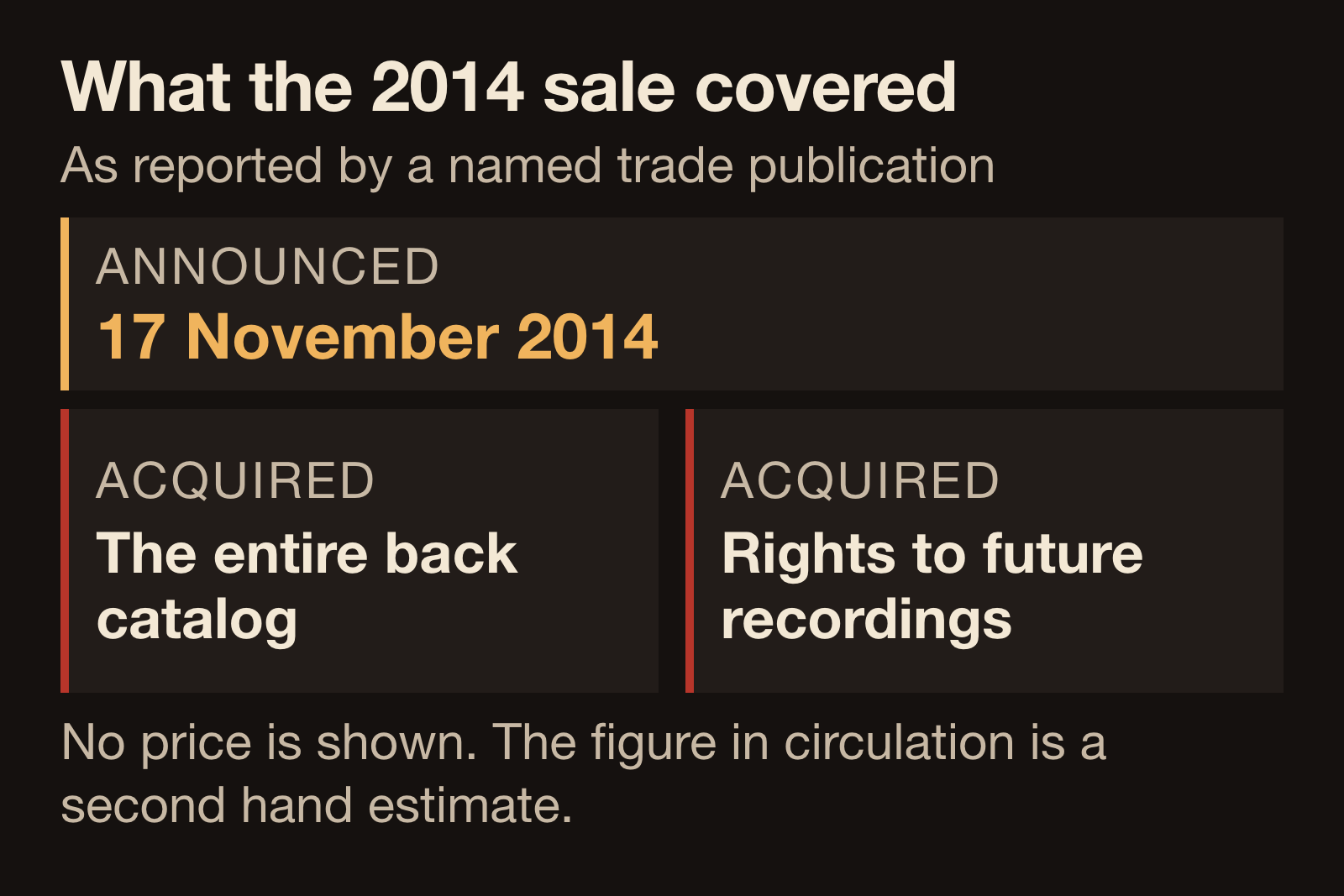
One caveat belongs on that section rather than buried. The buyer’s own newsroom page for this announcement returned a 404 at both candidate addresses we tried on 6 September 2026, so this article attributes the sale to a named trade publication reporting it, with two executives quoted on the record, rather than claiming we read a company release. That is a weaker source than a primary page and a stronger one than an encyclopedia summary.
A joint release with the label that owned this domain
Vagrant crossed paths with Staple Records at least once, and the evidence is on Staple’s own artist page rather than in any database. Dated 13 November 2014, four days before the sale was announced, the archived announcement says a Dustin Kensrue album was expected “on Staple Records/Vagrant Records” the following spring. One announcement about one record, which is all it establishes, and an example of the two imprints appearing in a joint release announcement.
What is still open
Two things this page deliberately does not give you. There is no founding year, because the search results disagree between 1995 and 1996 and nothing read here settles it. There is no sales figure, because the one that circulates is a trade estimate reported second hand, and an estimate is not a measurement.
The database record adds two things worth knowing while you wait for better sources. It files three sublabels underneath the main name, so a release can carry a smaller imprint and still sit in this catalog, and it lists three separate postal addresses across Massachusetts and California, without establishing the dates or reasons behind those address changes. Both are contributor entered fields, so treat them as leads to check rather than as settled facts.
The inspected archive range extends across several decades. Captures run from May 1998 to September 2026, a span of twenty eight years on one address. For comparison, the archive holds label pages for the imprint that owned this domain across four years.
The inspected mid-2000s captures have a different limitation. Those captures return navigation with no substantive readable copy, which is why nothing in this guide is quoted from Vagrant’s own pages of that era. What is verifiable is the present: vagrant.com is live and serving today, running as a storefront with an artists section. An ownership change in 2014 was not an ending. Our editorial standards cover how to send a correction if a primary source for any of the gaps turns up.