

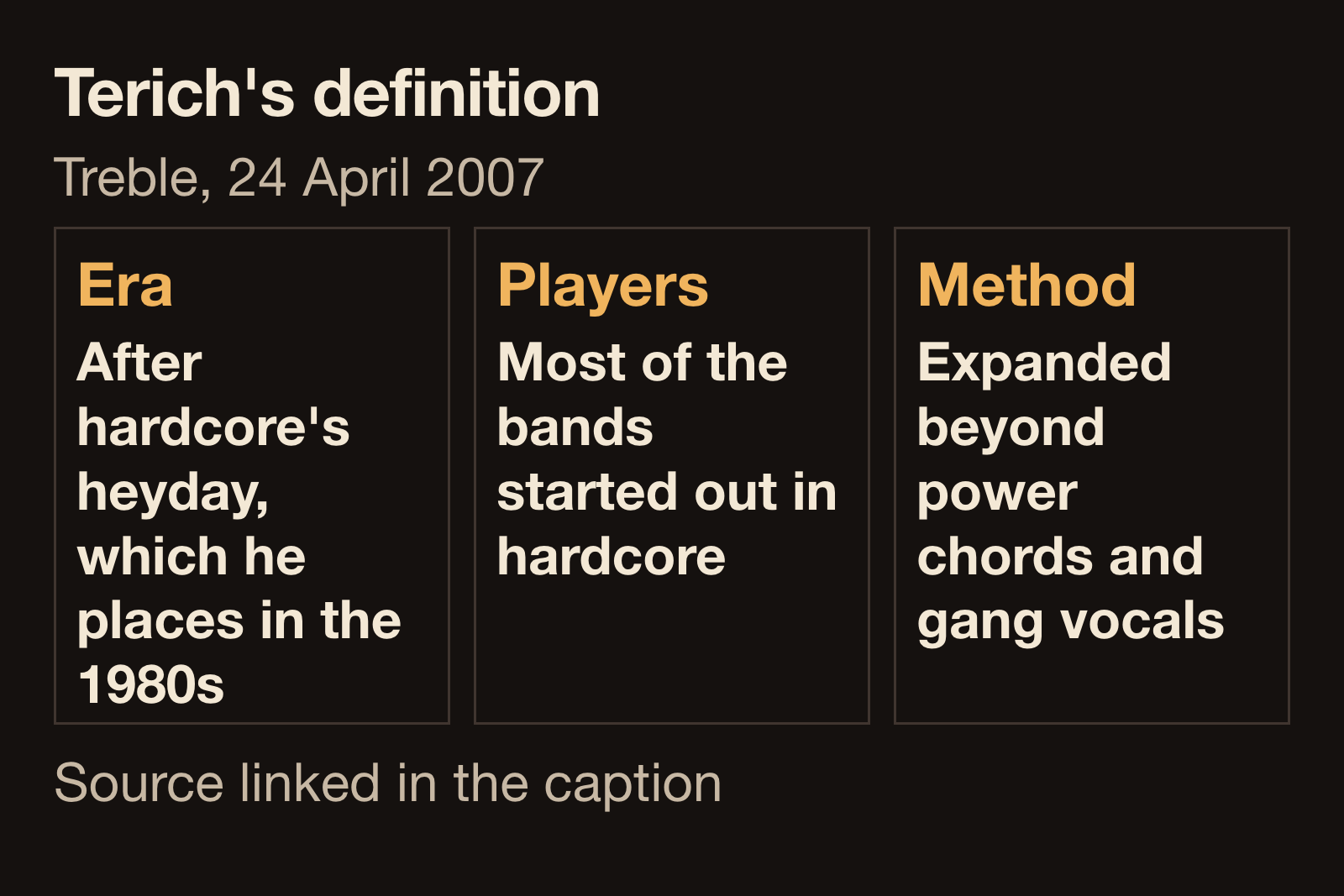
Jeff Terich’s definition of post-hardcore offers three questions to bring to a record: when it was made, where its players started, and how it changes hardcore’s musical approach. He wrote it for Treble on 24 April 2007, as the introduction to a listening guide. He concedes in his first paragraph that what counts is “subject to much debate”, then gives a definition anyway, and it is a definition about where a band came from and what it stopped doing.
That is more portable than a list of adjectives. Staple News is independent and has no affiliation with the original Staple Records label that used to own this domain.
A working definition, and who wrote it
Terich’s account has three parts. The first is era: he places the music after hardcore’s peak in the 1980s. The second is where the players came from, and he is specific about it, saying most bands in the genre started out in hardcore. The third is method: rather than keeping to hardcore’s rigid constraints, these bands changed the chord and vocal approaches they inherited while retaining that energy.
He hedges it in the same breath. He points at an ongoing argument on Wikipedia about what the genre covers, and says the net is wide enough to hold bands who made political statements, bands who made jokes, and bands who had hit singles. A definition that admits that much spread stays useful, because the three tests still run on an individual record.
Where the encyclopedia definition differs
The encyclopedia entry lands somewhere similar from a different angle. It describes the genre as keeping hardcore punk’s intensity while allowing more expressive freedom, and acknowledges how widely the term has been used. Terich anchors on the era and the players’ hardcore background. The entry anchors on what the music keeps and what it adds.
They also start in different places. The entry puts the beginning with Hüsker Dü and Minutemen, groups Fugazi, Big Black, Jawbox, Quicksand and Shellac together, then runs the same label forward to At the Drive-In, Underoath and Senses Fail in the 2000s. Terich’s guide opens on Big Black in 1987 and zigzags outward.
Three records and one departure
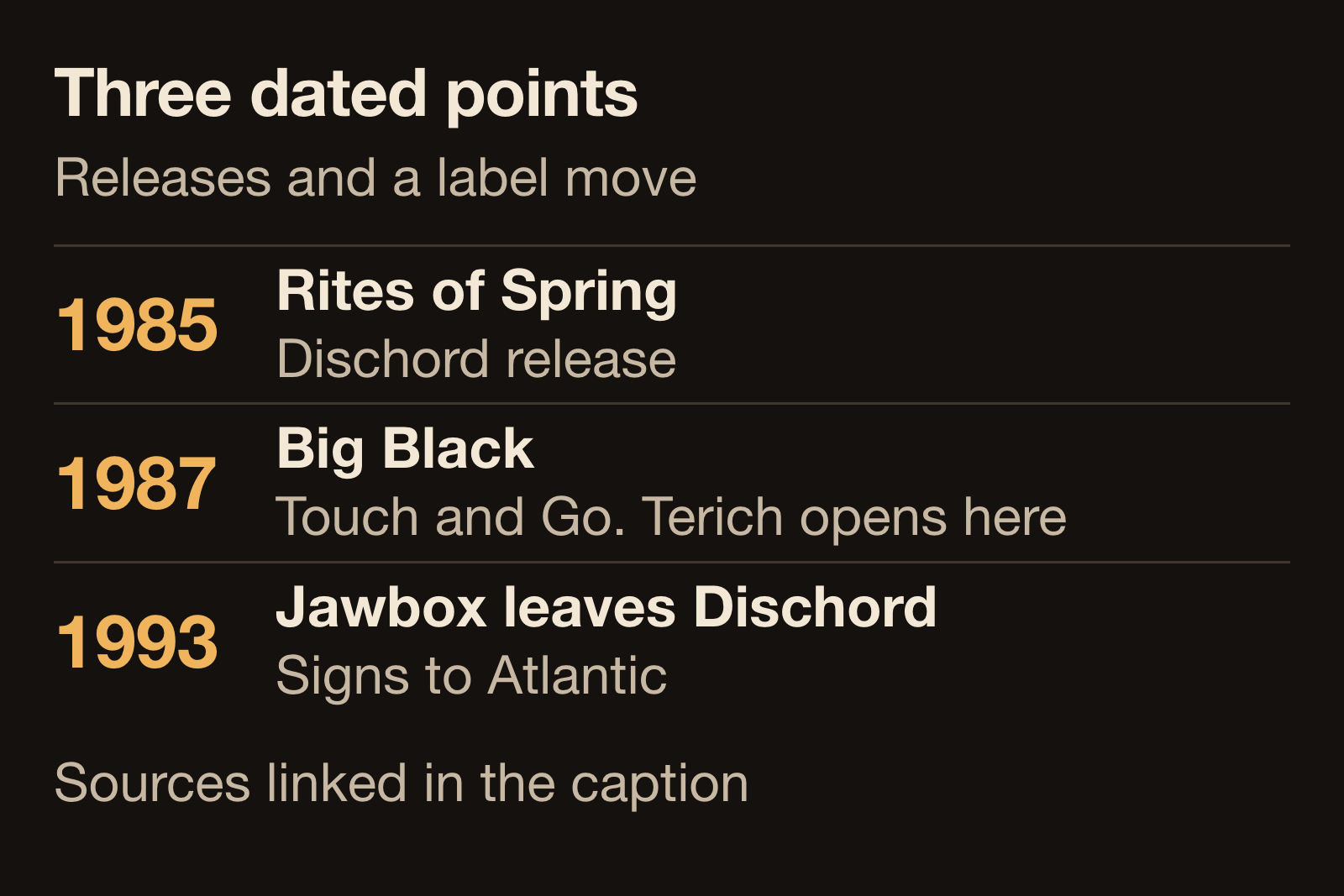
Terich’s opening pick is Big Black, on a 1987 Touch and Go album, a band he describes as forerunners who worked drum machine rhythms into abrasive punk. Two picks later he reaches Rites of Spring, on their 1985 Dischord album, and flags the thing the genre arguments usually keep apart: he describes them as an early post-hardcore band also associated with emo’s beginnings. Same band, both words, one sentence.
His Fugazi pick is Bed for the Scraping, from Red Medicine, dated 1995 on Dischord. He writes that the band were not the first but were the most influential.
A catalog number worth getting right
If you cite the Dischord page for Repeater, cite it carefully. The visible release line on that page reads Dischord 044. The address you arrive at reads /release/086/repeater. The 086 is the site’s own internal identifier for the page: 044 is the catalog number, and it is also what the page title and the artwork file the page loads both carry. Quoting 086 as a catalog number quotes a database row instead.
The rest of that page is plain: Fugazi’s first full length, released in 1990, with Ian MacKaye and Guy Picciotto on vocals and guitar, Joe Lally on bass, Brendan Canty on drums.
Jawbox and the decade the word marks
If the word marks anything concrete, it is what happened to bands like Jawbox. The label dates them 1989 to 1997, records that their first show was opening for Fugazi, and that their first single came out in 1990 as a split release between Desoto and Dischord. Two albums followed on Dischord, Grippe and Novelty.
Then the label writes the turn plainly: the mainstream industry “developed an interest in the underground music community” and moved toward bands with a work ethic and a proven audience. Jawbox left for Atlantic in 1993, made two more records, and stopped in 1997. Terich notes the same move happening to Shudder to Think, who started on Dischord and signed to Epic.
What the label pages carry instead
Five Dischord pages were read for this article, for Minor Threat, Rites of Spring, Embrace, Fugazi and Jawbox. On those five, the phrase post-hardcore does not appear. What they carry instead is dates, lineups, catalog numbers, pricing and label moves. The Fugazi page dates the first show to 3 September 1987 and describes the band’s practice rather than its sound, saying it “maintains a policy of affordable access to their work through low record and ticket prices and all concerts are all-ages”.
That absence is not the label rejecting the term, and genre tags do get attached to its bands elsewhere. Terich mentions a distributor listing that gave every Dischord band a genre, with most of them marked punk. One related data point, carefully scoped: asked in a 2003 interview whether he had invented emo, Guy Picciotto said “all the bands I played in were punk rock bands”. He was answering a question about emo, and that interview does not mention post-hardcore at all.
Using the word without arguing about it
Somebody posted in the genre’s own subreddit on 6 September 2026 asking what actually makes a band post-hardcore, and listed the labels they kept colliding with: emo, screamo, Midwest screamo, skramz. The replies were one line jokes.
Terich’s three tests answer that better than the thread did. Check the era, check whether the players came out of hardcore, check whether the record drops the format rules while keeping the intensity. Where the tests disagree with each other, the catalog number and the credit block on the record will tell you more than the genre tag will. Corrections go through our editorial standards page.