
Two musicians from the same Washington DC scene turned down the same word seventeen years apart. Ian MacKaye, on stage with Embrace around 1986, had just seen a skate magazine call his circle emocore. Guy Picciotto, in a 2003 interview, was told he had invented the genre. Read the two answers next to each other and each one reaches for music that was obviously already emotional before the label existed. That is a resemblance in the wording, and it is as far as the sources take it.
That is the most useful thing to know before trying to sort a shelf with these two words. Staple News is independent and has no affiliation with the original Staple Records label that used to own this domain.
Where the words came from
Both point at the same handful of months in 1985. Dischord’s own pages call that stretch Revolution Summer and describe it without either genre term, as bands who “preferred smaller more intimate venues and focused on a more personal and introspective interpretation of punk rock”.
| Band | Active, per the label | Record |
|---|---|---|
| Rites of Spring | Spring 1984 to Winter 1986 | End on End, Dischord 016, 1985 |
| Embrace | Summer 1985 to Spring 1986 | Dischord 024, LP issued 1987 |
End on End was cut at Inner Ear Studios and produced by Ian MacKaye with Mike Hampton. The band page records something easy to miss: across their whole existence they “ended up playing only 15 shows”. Embrace lasted three seasons and its album came out a year after the band stopped.
The Embrace page also explains who was in the room. MacKaye formed it with three former members of Faith, after Faith and Minor Threat had both ended within months of each other in 1983. So the band that gets cited as an origin point was assembled out of two hardcore bands that had just stopped, which is a continuity story rather than a break.
The two rejections, in their own words
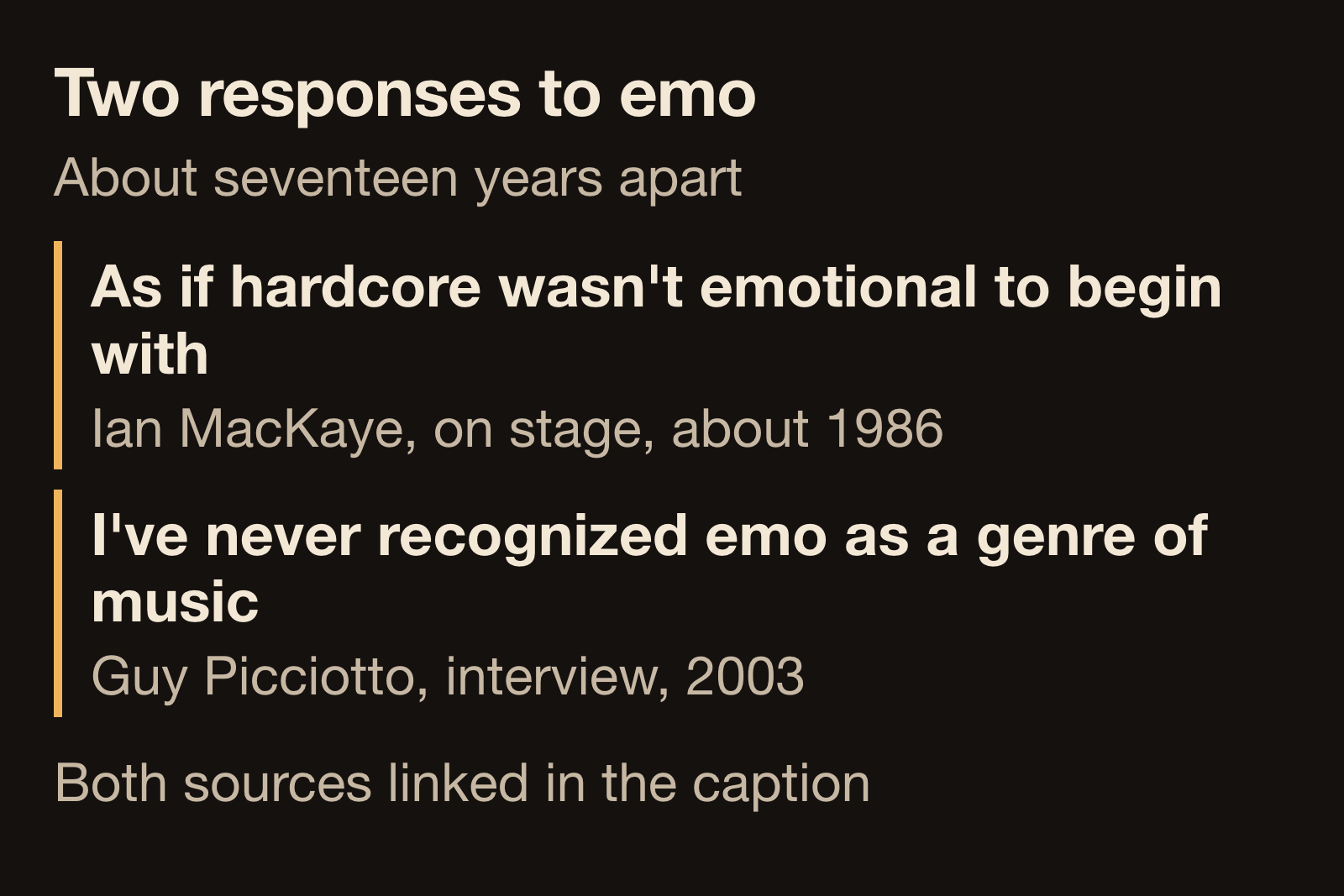
MacKaye’s remark survives because a camera was running at Nightclub 9:30. He mentioned that Thrasher had labelled his circle emocore, short for “emotional hardcore”, and answered it in one line: “As if hardcore wasn’t emotional to begin with.” That account comes from a 2022 survey of the question, not from the film itself, which we have not viewed.
Picciotto, asked in 2003 about being credited with inventing emo, said “I don’t recognize that attribution” and “I’ve never recognized ’emo’ as a genre of music”, adding that he had thought of every band he played in as a punk rock band. He then asked whether the Bad Brains were supposed to have been unemotional. That is the same move MacKaye made, naming an obviously emotional band and letting the label fall over. Neither account establishes that either man had the other in mind.
What the reference sources say the difference is
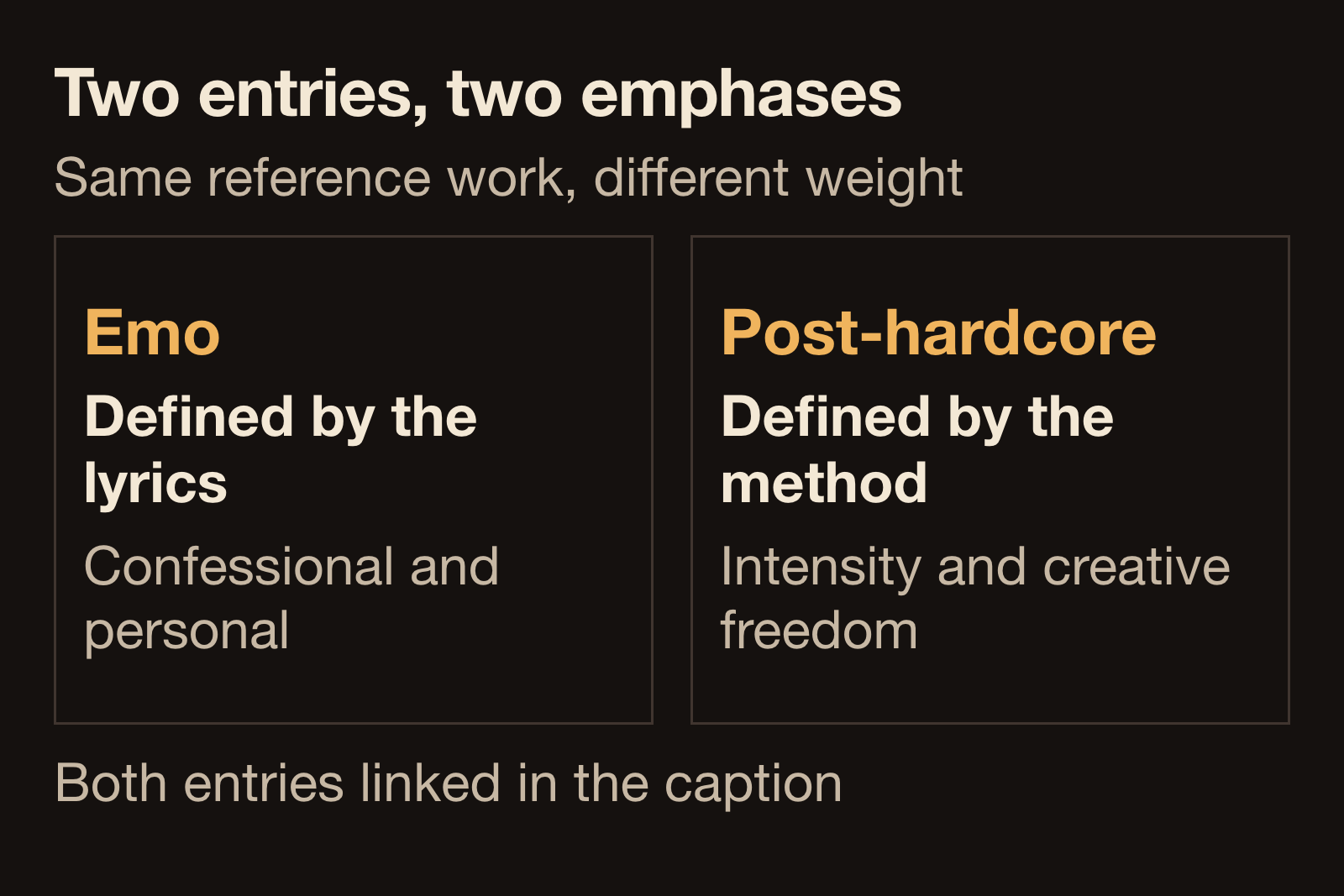
The encyclopedia entry for emo defines it by what the words do: hardcore punk musical characteristics plus “emotional, often confessional lyrics”. It also does not treat the two terms as rivals. It says emo “emerged as a style of hardcore punk and post-hardcore” from the mid 1980s DC scene, and names Rites of Spring and Embrace as pioneers. One sits inside the other.
The post-hardcore entry defines its term by method instead: aggression kept, “a greater degree of creative expression” added. Then it concedes the term has been applied to “a broad constellation of groups”. Read both entries together and the overlap is not a nuance, it is the situation. My Chemical Romance appears under emo on one page and under post-hardcore on the other. So does Senses Fail.
A named critic put both words on one band deliberately. In a 2007 Treble listening guide, Jeff Terich calls Rites of Spring “one of the pioneers of post-hardcore” and also credited among the first emo bands, in a single sentence, on his way to picking a track from their 1985 Dischord album. He describes the double billing as a dubious distinction and carries on. That is the overlap set down by somebody using both terms on purpose, rather than an accident of two separate reference pages.
Who is actually arguing about this
Across the three Dischord pages read for this article, for Rites of Spring, Embrace and Happy Go Licky, you get dates, lineups, studios, producers and catalog numbers, and neither word appears. On the evidence here the label as a publisher has not been the one applying them. Where the first one came from is documented: a skate magazine, in about 1986.
It is still with listeners. A community written tag page on one listening service exists specifically to define which records count as real emo. In the genre’s own subreddit on 6 September 2026 someone asked what makes a band post-hardcore and listed the labels colliding in their head: emo, screamo, Midwest screamo, skramz. A day earlier, on the emo subreddit, a listener dated a first wave from 1985 to 1993 and described it as DC hardcore trading rage for melody and self examination during Revolution Summer, which is close to the label’s own sentence written decades earlier.
What to do with the two words
Treat them as pointers to a period and a set of records, not as a test a band passes. The dates hold up: 1985 in Washington DC, two bands, two catalog numbers, one of them fifteen shows long. The definitions do not divide the same set, the sources that supply them say so, and the people who made the records declined the vocabulary twice on the record. If you have better sourcing on any of this, our editorial standards page explains how to send it.